Saturday, March 6, 2010

Piss Christ - Andres Serrano

When I was thinking about what to do my presentation on, I decided to do it on something controversial. I typed in “controversial Jesus artwork” into Google and “Piss Christ” by Andres Serrano was the number one result from the search. “Piss Christ” is an image of a plastic crucifix with Jesus on it and the whole thing is submerged in a bottle of the artist’s urine. When I first saw this image, I wasn’t offended or shocked. I never expected to see anything like this, but it didn’t have much a shock factor in my opinion. Art can take on many forms, this being one of them. I can see why it would offend some people. It does defame Jesus in my opinion though.

This work was produced in 1987. When first looking at the picture I saw Jesus on the cross with a lot of yellow throughout the whole picture. It seemed a little different because there were a lot of scratches on it. I didn’t understand why the picture would look like this. Then, I read the description and realized that this was a figure in a bottle full of urine. I didn’t really think of this as art, when first viewing it. Then, I saw that it won an award from the Southeastern Center for Contemporary Art.

This piece was first seen as controversial in 1989 after winning this award. New York Senator Alfonse D’Amato began receiving letters and phone calls from citizens about the painting. The citizens were shocked and angry at the sight of this painting. This is partly because the artist received $15,000 from the National Endowment for the Arts. The citizens could not believe that their tax dollars were being used for this sort of thing. The Senator himself could not believe that the money from taxes was being used for this. This caused him to take this problem in front of the Senate. He then wrote a letter to the chairman of the National Endowment for the Arts. In the letter he talked about how appalled he and the citizens were because of the artist receiving the money for that piece of art. He also said that he wants the Chairman to make sure that future winners are thought over more carefully.

D’Amato wasn’t the only Senator to go before the presiding officer about this artwork. North Carolina Senator Jesse Helms had a problem with it as well. He as well believed that “Piss Christ” was a blasphemous piece of work. He went as far as to call the artist a jerk and said that he hopes that he never has to meet the artist. Helms couldn’t believe that something so offensive would honored by receiving an award and money. He even called the National Endowment for the Arts flawed because of their choices.

In 1997, while on display in Australia, “Piss Christ” was vandalized by two youths. During this vandalism, a couple of staff members were injured. This was the second time that it happened to this photograph in Australia. A couple of weeks before a man actually tried to remove the painting. He was arrested and given a one month suspended sentence. These vandalisms took place in the National Gallery of Victoria. The administrators decided to close down the gallery because of unsafe conditions for visitors because of these vandalisms. Archbishop Dr. George Pell applied for an injunction to prevent “Piss Christ” from being exhibited because he believed it was a blasphemous piece of art. Justice Harper of the Supreme Court in Victoria, Australia denied the injunction.

Everyone didn’t find “Piss Christ” offensive. Surprisingly, Catholic nun and art critic Wendy Beckett didn’t find it offensive at all. She believes it shows what people are doing to Christ today.

Serrano has made some comments on “Piss Christ.” He believes that the best place for this piece of art is in the church. Serrano said that he held an exhibit in a church once and everything went smoothly. He even said that the Vatican would be smart to display it one day. Serrano said he ignored all of the stuff going on in the Senate because it was his way of not letting them change his artistic direction. This was all said in an interview, in which he was talking about why he was taking pictures of Ku Klux Klan members. This is a little controversial since Serrano is a Hispanic man. In this interview he also said that he believes that his work is religious, not sacrilegious.

Andres Serrano was born in 1950 in New York City. He attended the Brooklyn Museum of Art School. At one point in his life he became a drug addict, which put his artwork on hold for several years. He was most influenced by European art movements of surrealism and Dada.

“Piss Christ” wasn’t a change from his usual work. That is what makes me think he didn’t want it to cause such a problem. Most of his art involves bodily fluids from humans and animals. His “Madonna and child II” features Mary and Jesus submerged in urine as well. His latest work revolves around feces from himself and other animals. Also, Metallica’s “Load” and “ReLoad” albums feature his artwork as their covers.

References:

http://www.csulb.edu/~jvancamp/361_r7.html

http://www.communityarts.net/readingroom/archivefiles/2002/09/shooting_the_kl.php

http://findarticles.com/p/articles/mi_m1248/is_n7_v86/ai_21113230/pg_2/

http://www.artslaw.com.au/publications/Articles/97Blasphemy.asp

http://rogallery.com/Serrano_Andres/Andres_Serrano-Biography.html

http://cruciality.wordpress.com/2009/06/25/rethinking-serranos-piss-christ/


Wednesday, March 3, 2010

Christ The Redeemer


Christ the Redeemer is a gorgeous statue on the top of Corvocado Mountain in Rio De Janeiro, Brazil. This is one of the most instantly recognizable images in South America. It stands around 130 feet tall and overlooks the city of Rio. The Redeemer was voted in 2007 one of the New 7 wonders of the World.

The construction of this statue took many years to build, as well as to conceptualize. In the 1850s Pedro Maria Boss was a Catholic Priest who saw Corvocado mountain overlooking the city of Rio and wanted to put a monument of his faith there to overlook the city. In order to do this he needed the approval of Isabella, who was the Imperial Princess of Brazil at the time. He wanted to dedicate this monument to her. It did not work out as Boss had planned, Isabella was unimpressed, and the project never gained popularity.

In 1889, the monarchy over Brazil was overthrown and a new Republic was created. Not soon after this the separation of church and state was proclaimed once again bringing doubt about the possibility of the statue's construction.

It was not until 1921 when the idea was proposed again, supported by the archdiocese, that the creation looked possible. In order to gain funding the Catholic church in Rio held a "Monument Week" where Catholics throughout Brazil sent donations to fund the project, it was a huge success.

Once there was funding for this monument, Carlos Oswaldo was to design the statue. After multiple attempts to try and create a working design for the statue, Oswaldo was dropped from the project and a civil engineer by the name of Heitor da Silva Costa was hired after he came up with the idea for a Jesus with his arms outstretched in the shape of a cross on top of Corvocado Mountain. Corvocado teamed up with French sculptor Paul Landowski to create the statue.

The statue was built in France and brought to Brazil in pieces and assembled together on the mountain using the Corvocado railway. Christ the Redeemer was created using reinforced concrete underneath an outer shell of soapstone, in order to last rough weather conditions. It took five years and $250,000 to complete the statue and there was a huge opening ceremony in 1931 to celebrate its completion.

Costa is best known for his design of The Redeemer, but Paul Landowski had many other sculptures throughout France. Much of his work is surrounded by religion, such as a statue of David, a Reformation wall and many other religious monuments. There is a museum in Paris dedicated to him and contains over 100 of his works.

This statue is amazing in my opinion, not only because of the beauty of a peaceful monument overlooking the city of Rio, but because of its simplicity. It depicts is Jesus with open arms in the symbol of the cross. He does not have much of an expression on his face, and his eyes are not detailed. The statue leaves a lot to the imagination because it is so neutral. There is not much to argue about in this depiction of Jesus because Christ the Redeemer is a very nondescript piece of work. I think this was done for a reason.

With the separation of church and state in Brazil I don't think the constructors wanted to offend anyone. If they were to go into great detail, or have Jesus posing in some aggressive manner people could be easily offended. Because this is a monument for the entire city regardless of religion, I think it was smart to be very generic in Jesus' features and clothing. Jesus shows up in many religions, not just Christianity, so by having Jesus posed in such a peaceful manner with open arms, it is probably easier for everyone to appreciate as a symbol of peace.

The state of the city of Rio is another reason I think this monument is so attractive. Rio is a very rich city in some areas, but is known for its dangerous slums and violence. In a place that is known throughout the world for both its beauty and its danger, it is very fitting to have a statue of Jesus overlooking the entire city, I think it can give hope to a lot of people.

This is such an important monument to the people of Brazil that they are currently raising money again to repair the cracks in the statue which will take around six months to complete.

Resources: http://www.ilovefiguresculpture.com/masters/france/landowski/landowski.htm,http://www.google.com/search?q=christ+the+redeemer+rio&hl=en&client=firefox-a&hs=7rQ&rls=org.mozilla:en-US:official&tbs=tl:1&tbo=u&ei=hMCLS-D5Io7WNb-S2KUB&sa=X&oi=timeline_result&ct=title&resnum=12&ved=0CDQQ5wIwCw,http://www.npr.org/templates/story/story.php?storyId=11626074,http://modern-latin-american-history.suite101.com/article.cfm/history_of_christ_the_redeemer_statue_brazil

Monday, February 22, 2010


Painting the Divine

When choosing a piece of artwork for this assignment, I hoped to find a painting that represented an interpretation of the birth of Christ to create an appropriate segway for our classroom discussion. I had a difficult time finding anything put the typical nativity scene.

However, when I stumbled upon this particular painting I was captivated by its many different components.
After doing some research, I discovered that the original painting is on a 10 X 17 foot canvas. It was painted by Brian Kershisnik, an artist from Utah. He earned his bachelor at Brigham Young University and completed his graduate studies in Austin, Texas. He now resides in Utah, where he is deemed one of the finest artists in the state. This particular painting is from 2006, and was a project that he didn’t have a whole lot of thought or preparation for. In a speech he gave to BYU, he originally started the project to prove to his art students that he “still had game.” However, this particular painting entitled “Nativity” did more than just prove that.

It would seem that the most common response to Brian’s painting is a positive one. Yet, it does not posses the normal components of the nativity scene. I found myself not only analyzing the painting, but also completely captivated by it. What did Kershisnik intended to demonstrate through this wildly different interpretation of Christ’s birth? Fortunately I discovered a speech on his “Nativity” where I was able to different factors about his artwork.
First and foremost, there are the angels. This is probably the most captivating part of the painting- they completely surround Mary, Joseph, Jesus and the midwives.

When I first saw the painting, my first reaction was that there the Bible tells us there are only twelve angels: Revelations 21:12- It had a great, high wall with twelve gates, and with twelve angels at the gates. This painting seems to suggest there are a great deal more- and not only that, but also that angels are of all ages.

This is perhaps why I immediately took these angels of many shapes and sizes to exemplify followers of Christ. The angels closest to Jesus and even the angels on the entire left side of the painting are longing to be nearer to him. Even the children and babies are reaching out, unable to look away from him. The angels on the right side of the painting seem to be rejoicing to God- as if they are unable to contain their graciousness after experiencing Christ. It seems to suggest that they long to spread the word of Christ.


In the speech Kershisnik gave to BYU, a woman asked him why all the angels were white. Kershisnik confessed he encountered this question quite a bit. He replied to the woman that when he paints, he paints what he knows. He paints in his own “language.” He went on to say that he would certainly never question a Hispanic nativity or a black nativity- but assume that it connected or expressed whoever created it. This notion of race is an interesting one, because according to Jesus would actually be more Arabic than how he is commonly represented in the Christian church.


This brings me to another aspect of the painting. Baby Jesus is darker than he is normally depicted in the nativity scene. This could be interpreted in a couple of different ways. Jesus was just born, and if this is realistic portrayal of that- it could be argued that he hasn’t been cleaned yet. This argument could be supported by the fact that the midwives in the painting seem to be washing their hands from the blood of the birth.

This is actually a factor that was commented on in a Latter Day Saint’s magazine entitled Meridian Magazine (www.meridianmagazine.com). One man (a pediatrician) interviewed by the magazine at an art exhibit displaying “Nativity” expressed the idea that he thought the size and newness of baby Jesus reminded him of his earthly birth. Here was this magnificent event; but it was also like a million births that took place before it and after it. He went on to say that every birth has a similar moment such as this one- a “holy” moment.


After the angels, the second thing that struck me about this painting was, of course, Joseph’s expression. At first glance, he seems almost greatly upset. However, after a second look it seems that he is overwhelmed. His hand lies lovingly on Mary’s shoulder, but it is almost as if he needs to be the one who is comforted. I think this brings a lot of issues up about who Joseph was to Jesus. He was not biologically related to Christ, yet his wife carried this child and was his earthly mother. Perhaps Joseph has realized that he is responsible for this child- this tiny helpless creature is completely dependent on his care. This in itself is a pretty life altering realization, not to mention the tiny factor that this infant is the Son of God. I would certainly be making this expression too.


Kershisnik expresses in his speech at BYU a very similar explanation to how the pediatrician in the magazine interpreted Joseph, Mary, and Jesus in the painting. He wanted to express this idea of humanly birth. He wanted to connect this heavenly event to something that many experience at least once in the course of his or her earthly life. There is something so divine, so majestic about the birth of a new child; there is something almost Christ like about the event. In the article in Meridian Magazine, it stated that many of the people who came into the exhibit were moved to tears. Even looking at a much smaller version of this painting gives me goose bumps. Kershisnik expresses this perfectly divine yet incredibly normal event in such a way that it is almost impossible to not feel shaken with its simplicity.


References

http://www.kershisnik.com http://newsnet.byu.edu/story.cfm/66762 http://www.meridianmagazine.com/arts/070613nativity.html http://www.kershisnik.com/change-image.php?current_image=20

Sunday, February 21, 2010

Jesus Is My Homeboy


Jesus and religion continue to pop up through modern art and style. From the small WWJD bracelets that were all the rage in the 1990’s, to the crosses on graphics of t-shirts at The Buckle, connotations back to Jesus and Christianity always make a powerful statement. This statement was made strongly and worn by celebrities everywhere with the “Jesus Is My Homeboy” shirts. Although these shirts may seem like they are making a mockery of the relationship one has with Jesus, the message created by Van Zan Frater actually tells of the power of Christianity and the possibility that Jesus really can make a difference in everyday life.

“Jesus Is My Homeboy” t-shirts broke onto the scene in 2004. The shirts began being sold in Urban Outfitters; however, they are sold in many different stores today. They can also be bought online through the shirt’s official website. Not only can one buy t-shirts with this saying screen printed on them, but a customer can also buy “Jesus Is My Homeboy” bags, aprons, and coffee mugs. Before even beginning my research into what the Jesus Is My Homeboy shirts really mean, I had to lay aside my original connotations regarding the shirts. Since these types of shirts were often worn by celebrities and sold at places like Journey’s and Urban Outfitters, I initially thought they were downplaying the importance of Jesus in many Christians’ lives. This turned out to be quite the opposite.

The story of how these shirts began to rise through the ranks of popularity derives from one man who had an unfortunate run-in with a gang in the 1980’s. According to the official website of “Jesus Is My Homeboy”, Van Zan Frater had recently moved from Texas to Los Angeles. One night, when Frater was driving in Los Angeles, he needed to use a pay phone. Since this was before the days of cell phones, Frater had to pull over at a liquor store. As he was using the pay phone, a group of boys began hassling him. Van Zan Frater knew that he was dealing with some sort of street gang, and he also realized that these boys were very young. One of the younger boys hit him and put a gun to his head. The boy cocked the trigger and looked around for approval from the rest of the boys in the gang. Van Zan Frater knew he had to do something, so he simply said, “Jesus is my homeboy and don’t you know that Jesus is your homeboy too,”. The boy took the gun away from Frater’s head. The entire group felt the power of what he had said, and understood the message.

Van Zan Frater knew what had saved his life that night, so he wanted to spread the message through a silkscreen print on t-shirts. The print was made, however, it was lost due to the Los Angeles riots in 1994. Years later, the silk screen was found by men who thought it would be a great idea to make t-shirts out of the saying, and they were distributed all around the country. Van Zan Frater had no idea that the production of his image had actually become real life until several years after he had intended. In fact, he maybe would have never even known if it were not for the front page of People Magazine. The image and saying was created by one small moment, however, it has made an impact on many different people. Van Zan Frater simply made the image to depict the idea that Jesus was for everyone.

A very important aspect of the image that has been replicated so many times onto t-shirts and hats is the fact that it is not signified by a certain race. It is not just the stereotypical European-looking Jesus that we have seen so many times in so many different pieces of art. It has no racial specific traits. Van Zan Frater did this specifically to show that Jesus can be there for everyone, no matter his or her race, ethnicity, or background. Jesus can be someone’s “homeboy” who grew up in the ghetto or for someone who grew up in a white-collar family in the suburbs. It does not matter, because the power of Jesus is just the same.

Through looking at the Jesus Is My Homeboy image and the body language that is represented, Jesus looks like a very kind and comforting person. One can see this by his arms being outstretched in a sort of “come here” way. Frater really wanted people to get that feeling and for them to embrace Jesus. Through embracing Jesus, Frater hopes that random acts of gang violence can be avoided. Van Zan Frater began the Jesus Is My Homeboy Foundation in 2007. This foundation benefits from the sale of the saying. A portion of each sale goes to the foundation that helps people who are affected by gang violence. He is also currently writing a book to help victims of these types of crime.

My original connotation of what “Jesus is My Homeboy” signified was definitely not the case. The saying was not really looking for the popularity of people like Ashton Kutcher or Jessica Simpson, it was simply looking for a way to express the love and potential for Jesus in everyone’s lives. I feel like this story is extremely powerful. The way that Jesus is portrayed in the shirts is very important because it has gone into the popular world and popular style. No longer are the days that one’s expression of religion is looked at negatively or with a certain stereotype. Jesus has the possibility to be everywhere and anyone’s “homeboy”.

Tuesday, February 16, 2010

Osama bin Laden and Jesus

This piece of artwork, depicting Osama bin Laden “morphing” into Jesus is causing quite a stir in Australia. The illustration is three images, one of Osama bin Laden, one of Jesus, and the one in the middle a hybrid of the two. It was created by Priscilla Bracks, an Australian artist, who said she did not intend to be offensive. She claims she wanted to create a discussion on what is and is not religiously acceptable.


Ms. Bracks has said that there are many ways to interpret her work, but most people are mistakenly focusing on the most controversial interpretation: that she is comparing bin Laden and Jesus. She said she questioned whether Jesus could be in a cult-like status similar to bin Laden, while also looking at the comparison between good and evil. She also wanted to highlight how glorified bin Laden is in some areas of the world.

According to her biography, Ms. Bracks practiced law prior to obtaining a degree in photography in 2002. She says that she is “interested in the interplay between human nature, social-justice, law, media, and contemporary social, political and environmental issues,” which explains somewhat her reasoning behind such a controversial piece of art. Her overarching project, called Making the Empire Cross, discusses the relationships in popular ideology, truth, and history.

Personally, I think that Ms. Bracks wanted to attract attention by comparing the most wanted man in the world with a religious figure. It is not a very significant piece of artwork, nor does it use new or revolutionary techniques. In order to gain popularity, she created a more controversial piece of art, and it was a successful maneuver. Created in 2007, this modern piece of art capitalized on the constant man-hunt for Osama bin Laden and the terror his image invokes. This depiction of bin Laden and Jesus attracted interest to her ongoing series, Making the Empire Cross. This work is very different from her usual works, many of which use Barbie, not Jesus.

This image is not directly related to any biblical text. The image of Jesus is a typical depiction in the Western World of Jesus. In the image he is a white man, with a holy aura about him. It is the lack of any biblical significance or parallels in her other works that lead me to believe that this was simply a publicity stunt. There is no clear cultural perspective in Ms. Bracks’ artwork either. Her other works of art are typically commentary on current social issues, but not usually in the same vain as this work.

If one dismisses the possibility that this piece of art was simply a publicity stunt, it is possible that the artist could be addressing how easily cults can form around popular figures. There have been several large Christian cults, and no one can dispute that Osama bin Laden has created a cult-like following. However, even this idea is not clearly depicted in this piece.

This piece of art was entered into a prestigious religious art competition in Australia, despite opposition from the Prime Minister John Howard and his political opposition, Kevin Rudd. (There was also a statue of the Mary wearing a burqa in the competition.) Neither of these controversial pieces won. Instead, a retelling of the Stations of the Cross won the prize.

For more information on this piece of art, please see the following websites:
www.priscillabracks.com

http://www.news.com.au/couriermail/story/0,23739,22332714-953,00.html


-


Saturday, February 13, 2010

La Pietà - Michelangelo's Jesus Through the Years

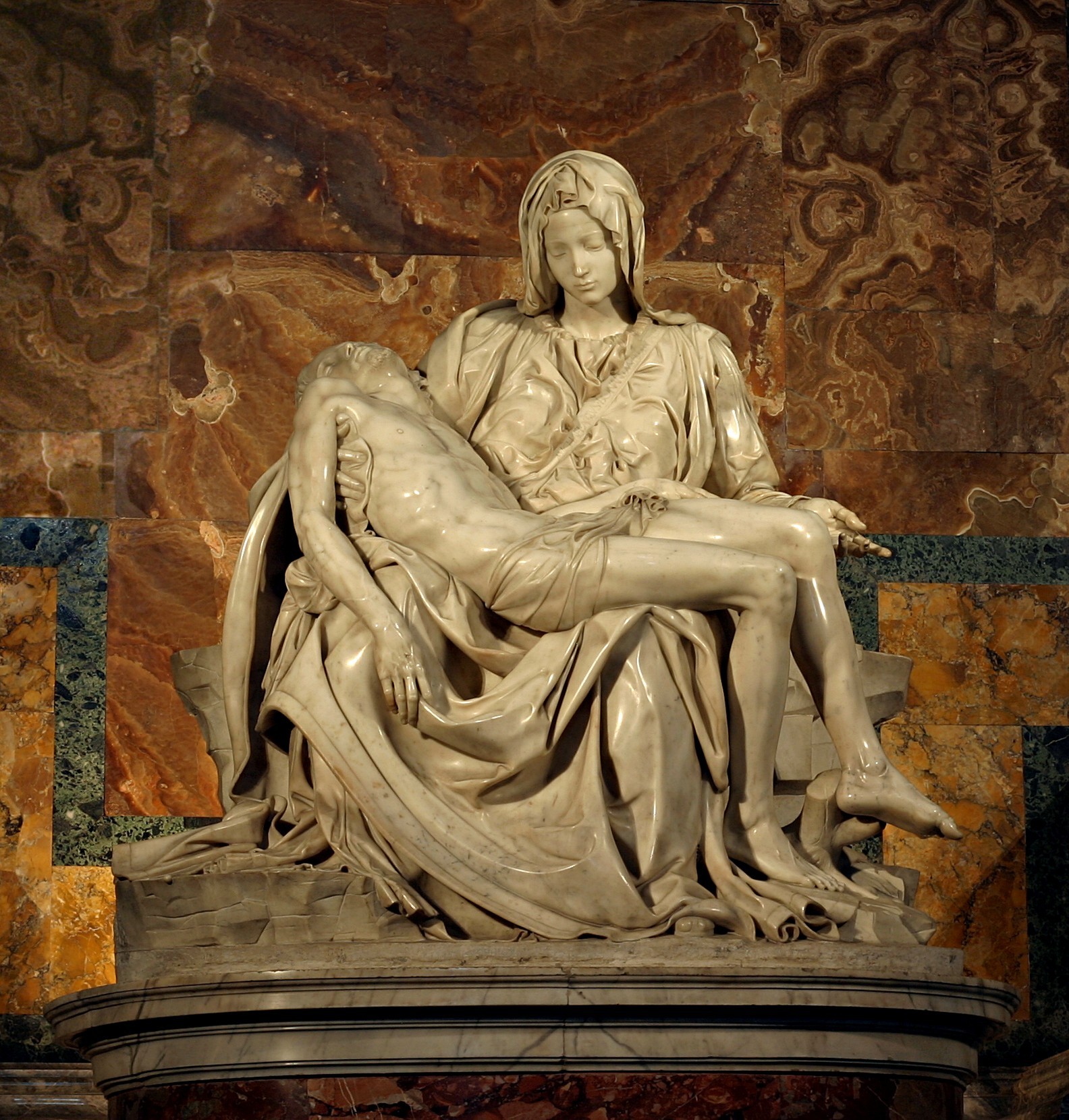
Michelangelo’s La Pietà (1499) endures as one of the greatest sculptures of the Renaissance era, and all-time. The life-like marble statue depicts the dead body of Jesus in the arms of his mother, Mary. The sculpture captures an intimate moment that is not explicitly shared in any of the four gospels. Presumably, Mary held her son’s body when it was removed from the cross, before Joseph of Arimathea arrived to clean and bury it in his own tomb. The canonical texts allow readers to project their own interpretations of what happened in the times between major events. For example, Matthew 27:50-56 describes the death of Jesus on the cross, the ensuing earthquake, and reaction by the witnesses. All these things happened during the day (Matthew 27:45.) The very next verse (57) skips ahead to the approach of nightfall and the appearance of Joseph of Arimathea.

What happened in the hours between the death of Jesus and the arrival of Joseph of Arimathea? Michelangelo attempts to address this question, among others, in his earliest rendition of La Pietà. Later in his career, the Renaissance master began other sculptures of the same theme, most notably the Pietà Palestrina (1550), and the Rondanini Pietà (1564); Michelangelo did not complete the later Pietà (pl.) before his death in 1564. The earliest Pietà (the word means pity, in Italian, and is used as a generic term to describe all works depicting this historical moment) is the only of these three works to be fully finished. It was commissioned by Cardinal Jean de Billheres, and originally stood at his funerary chapel before being moved to St. Peter’s Basilica. The Cardinal undoubtedly imposed his vision for the piece on the artist, which accounts for the dramatic departure in style and message of Michelangelo’s later Pietà, which he created of his own accord.

La Pietà

In looking at the physical representation of Jesus in each piece, we can read what the artist was trying to convey about Jesus, his relationship with Mary, and his followers’ relationship with him. La Pietà bleeds with emotion, though Jesus and Mary’s faces are seemingly neutral. Of course, Jesus is dead so too much expression on his face would be counterintuitive, but some viewers are surprised by the stillness on Mary’s face, considering she holds the body of her dead son. Her left hand is positioned with an open palm, reminiscent of meditation images seen in Eastern art. Can Mary be at peace after witnessing her son’s crucifixion?

Other aspects of Mary’s appearance tell us more about the way Michelangelo perhaps wanted Jesus to be seen. Mary is shown supporting the body of a fully-grown man on her lap. In a practical sense, that is difficult for the average woman to do. In La Pietà, Mary’s figure is actually larger than that of Jesus. Her bottom half forms a sturdy base for the body of Jesus. Even though the piece is life-like, it is not realistic in this sense. Mary’s size makes Jesus look small in comparison. This has been interpreted to mean that Mary is actually holding baby Jesus, but the viewer of the piece sees a glimpse of the future, in which Jesus is an adult. Though it is somewhat valid, this complicated theory was never supported by the artist himself or any contemporaries and thus is not widely supported today.

Close View of Jesus and Mary's Faces

The pressing issue concerning Mary’s appearance is, why Michelangelo depicted her with such youthful features. If Jesus died at or around age 30, Mary would have been approximately 45 years old. The Mary of La Pietà has the face of a teenage beauty. With that said, Jesus himself has the face of a much younger man. What does this youthful portrayal of Jesus and Mary say to viewers about their nature? It suggests that both characters embody innocence, which is a common quality of youth. There is conceivably no woman more innocent than the Virgin Mother, and no man more innocent than the Son of God (the Infancy Gospel of Thomas begs to differ.) Michelangelo said,

“Do you not know that chaste women stay fresh much more than those who are not chaste? How much more in the case of the Virgin, who had never experienced the least lascivious desire that might change her body?”
Mary’s youthful appearance is important to the viewer that subscribes to the Holy Trinity, and chooses to see her both as the mother
and daughter of Jesus/God. The parent-child relationship is a likely aspect of the artist’s intent. In a study on Early Christianity, James S. Jeffers noted that the term pietas originally referred to the sense of duty a child had toward their parents. Romans later likened that sense of duty to a person’s obligations to their god(s). In a complicated parent-child/human-God relationship like that of Jesus and Mary, we can see the lines of pietas crossing in every imaginable way. I think La Pietà reflects that complication very well. As we see the pair situated on the rock at Golgotha, Jesus is weak in death but supported by a strong yet somber Mary; Mary is simultaneously a weak human, looking to her God for comfort.

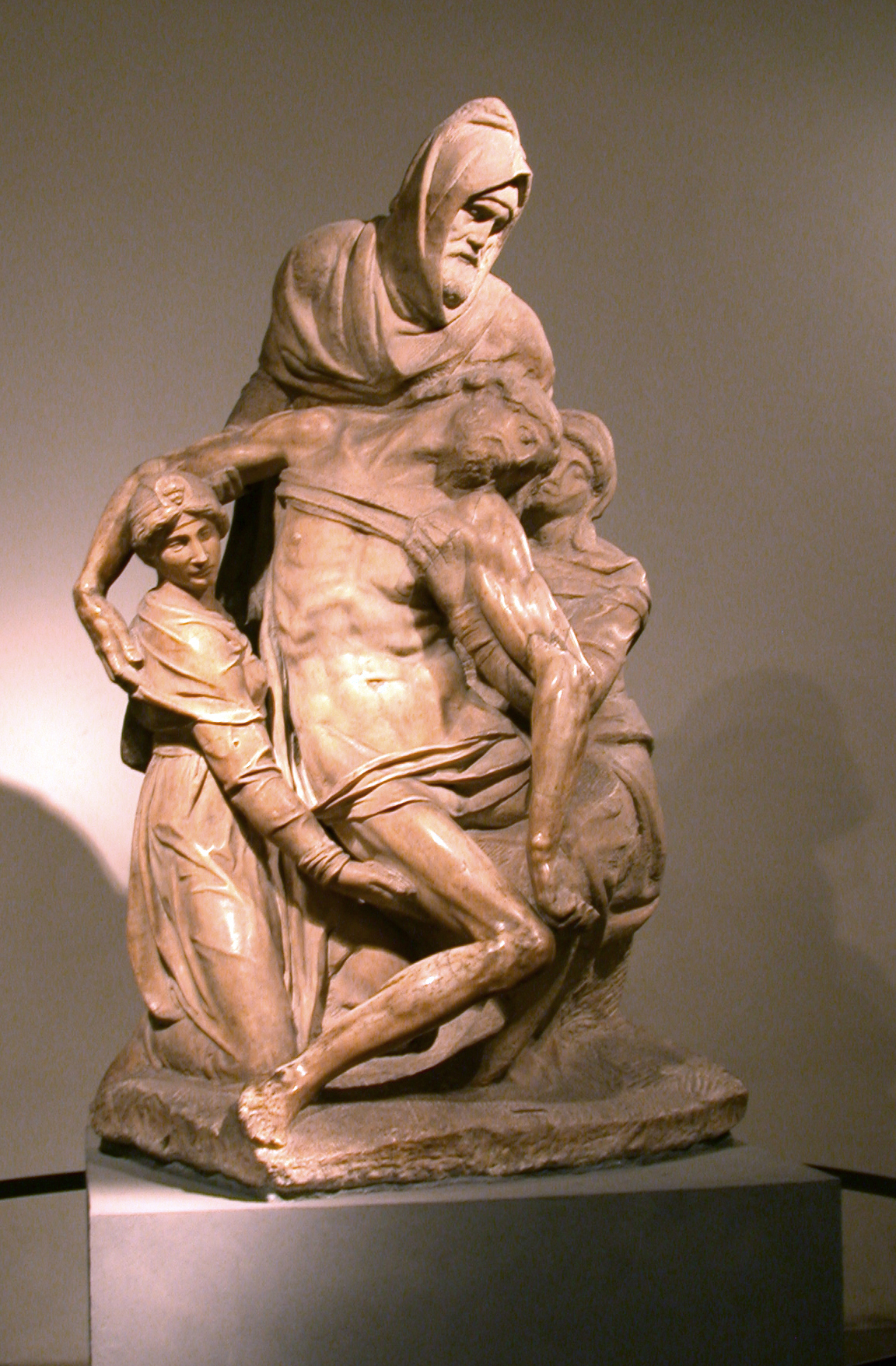
A brief consideration of Michelangelo’s later Pietà is in order. The Pietà Palestrina shows the body of Jesus supported by two figures. Mary is on the viewer’s right side, and a man is holding the body from behind. As mentioned above, Michelangelo began this work for himself. It is widely accepted that pupils worked on the statue after his death, which accounts for signs of inferior craftsmanship on the periphery, and eventual abandonment of the project before its completion. The man behind Jesus could be a representation of God. It is likely that he was supposed to be Joseph of Arimathea, who is identified in the Bible as caring for the body of Jesus. As in Michelangelo’s Florintine Pietà, the artist’s own face was likely put on the Joseph of Arimathea figure. It should be noted that the size of Mary makes more sense here, in relation to the men beside her.

Pietà Palestrina

The Rondanini Pietà is interesting in that it shows Mary tending to the body of Jesus from above. This is commonly interpreted as Mary on the back of Jesus, which is a sign that Jesus, in spirit, is actually supporting Mary. It is fitting that Michelangelo would turn to this view of Jesus in his dying years.

Rondanini Pietà (alternate view)


Links to Related Images:

Tuesday, February 9, 2010

The Crucifixion of Christ

Politics and religion have been two topics that are never suppose to be talked about at dinner, and haven’t ever easily coincided with one another. There are two stances that one can pull from the scriptures of Jesus’ life, one is that he did not come into this world to take over governments, and the second is that if you put Christ at the head of the government all the problems of the world would be solved. The way politics and religion are currently in the United States is known as a separation between church and state, therefore the two topics should, on paper, never influence or conflict with one another. Separating the two would be nice if it were possible but there is no easy way to say that someone who grows up with views against abortion and gay-marriage wouldn’t persuade them to vote toward the conservative side. Also the conservative side can use these social issues to their advantage to win over the votes of people who hold those religious beliefs. The artist who’s painting I have chosen, Becki Jayne Harrelson, states that she paints the paintings she does because she is “interested in the transformative possibilities of deconstructing classical or mainstream spiritual representations so one can see that how God is constructed, so is the political power that impacts the human condition” (becki.jayne.com). Her focus is on the main political issues of current day society, and how they can relate back to stories from Jesus’ life. She paints to show that just as we know God to be defined, our reality and our laws are also defined in the same way, and the two will always influence one another. Everything that she paints, like most artist, has a basic meaning, however her point is that if you take the basic meaning of her art you will miss the underlying point of why she painted what she did. Her outlook on religion and politics is this, “America was founded by a people seeking freedom from religious persecution. Today, its Old World roots are showing. Mainstream religions shape the fundamental quality of life permeating every aspect, from prayer in schools to political actions” (becki.jayne.com).


The painting of Becki’s that I chose is called “The Crucifixion of Christ.” It is a picture of Jesus at his crucifixion, he is shedding blood from his hands and feet, on top of the mount, the sky is dark and there is a sign above his head that says “faggot” where in a typical crucifixion of Christ it would say something having to do with “King of the Jews.” The first reaction I had to this painting was initial shock that Becki would actually be attempting to say that Jesus was a homosexual. I questioned, “is that really what this political debate is coming to now?” First of all they legalize gay-marriage and now people are going to try to prove that Jesus was a homosexual? Then as I started to read about why she painted this I realized a completely different view. Becki starts off her background information on this painting, “you miss the primary point if you think I’m saying Jesus was gay” (becki.jayne.com). She then goes on to explain how she wanted to paint this picture to show how every time hatred and violence is used toward one another Christ is crucified. Becki says instead of the word faggot one could, “substitute the word Nigger, Jew boy, honkie, redneck, or bitch – it all means the same” (becki.jayne.com). Her reasoning behind choosing the word Faggot has to do with the way homosexuals are currently perceived in society, for the most part they are accepted by cultural means, however from a religious stand-point there is more hate than love being expressed toward homosexuals. Jesus in his time was also made a hate target, the Romans were threatened by him, many others were skeptic, and the citizens of Rome hated him so immensely that they had him crucified instead of a man who justifiably should have been killed. No matter what day and age daring to be different will probably make you a target for hate. Becki Jayne takes a liberal stance on gay-marriage, she sees us all to be children of God and to be comfortable living in our own skin and she thinks that there is no difference between someone who is a homosexual and someone who is left handed. She ends her description of the painting with this statement, “Religion judges homosexuality as sin. Seek God first and listen to no other authority. But beware. Ironically, such spiritual courage can lead to crucifixion” (becki.jayne.com). Becki wants to leave gay-Christians with hope in her painting, Jesus was persecuted for standing out against the religion in Rome, and homosexuals are standing out against what current day religions say about homosexuality, but she encourages them to go into the world, be themselves and they might be persecuted but sometimes that is the price you have to pay for others to live without pain. Biblically this can relate to the verse in John Chapter 18:36, “My Kingdom is not of this world. If it were my servants would fight to prevent my arrest by the Jews. But now my Kingdom is from another place” (KJV). Jesus was crucified for following what he knew was true in his heart, knowing that regardless of what the Romans said or did, he would follow what he believed. That is what Becki wants her audience to do as well, stand up for what you believe is right, even if it leads you to crucifixion.

Becki Jayne is an innovative artist who is not afraid to take a leap of faith in her paintings by meshing largely debated issues with religion, even if it puts what we see as religion at stake. In a review of her art they state, “Becki Jayne Harrelson’s almost monumental canvases speak directly to that deeply felt realization that what we have been taught by most of our religious leaders is, to put it bluntly, crap” (becki.jayne.com). That is exactly right, she finds a way to paint in a way that to many it may seem offensive and against everything they have been taught, but that is her point. As Christians we need to take a stand against what is being taught in religions that aren’t changing with the times, and if that means someone speaking out for being a homosexual and being socially crucified, then so be it, Jesus did it too right? In conclusion religion and politics will always play a role in each other’s arguments; however it is up to the individual to decide what they want to believe in with both religious and political issues.

http://www.jesusinlove.org/artthatdares/atd3-harrelson-z.html